If you are planning to build or buy an Airbnb clone, most people will only look at the features first.
Property listing, search, booking, payments, messaging, host dashboard, admin panel and mobile apps are some of the common things you will check and there is nothing wrong with that.
But there is another important thing that you should not ignore.
The tech stack behind the Airbnb clone.
The technologies used to build the platform can affect its performance, security, customization and how easily you can work on the product later.
This becomes even more important if you are buying an Airbnb clone with complete source code. Your developers should be able to understand the code, make changes and add new features when your business grows.
So, let us take a closer look at the technologies used to build an Airbnb-like vacation rental platform.
What is an Airbnb Clone?
An Airbnb clone is a readymade vacation rental platform built with features similar to an online rental marketplace like Airbnb.
Instead of building everything from scratch, business owners can start with an existing platform and customize it.
A typical Airbnb clone can include a web platform, guest and host mobile apps, an admin panel, property listings, booking, payments, messaging, reviews, availability management and other features needed to run a vacation rental marketplace.
But all these features need a proper technical foundation behind them.
That is where the tech stack comes in.
What is an Airbnb Clone Tech Stack?
In simple terms, a tech stack is a group of technologies used to build and run your platform.
For an Airbnb clone, there is normally more than one technology involved.
Because, you need
- something for the web platform.
- a backend to handle business logic.
- a database to store information.
- Mobile apps for Android and iOS.
- APIs to connect everything together.
Apart from this, there are technologies used for authentication, messaging, notifications, payments and other third-party integrations.
So, choosing an Airbnb clone tech stack is not about selecting one programming language or framework. All these parts need to work together.
Few things to consider before choosing an Airbnb clone tech stack
1) Scalability
Your platform may start with a few listings and users.
But what happens when you have thousands of user and listings?
And what if hundreds of bookings are happening in same time or same hour?
The technologies you choose should allow the platform to handle more data and traffic (users) as your business grows.
You should also think about this before buying any readymade rental software. Moving to a completely different technology later can take a lot of development work.
Nobody likes a slow website or mobile app, especially I don’t.
Guests should be able to search properties, apply filters, view listing details and check availability without waiting too long.
Hosts also need to manage listings, calendars and bookings without performance issues.
So, the frontend, backend, database, and server setup all have a role in keeping the platform fast.
3) Customization
This is an important point if you are buying an Airbnb clone.
Your business requirements may change later or you might be thinking of adding or removing a feature.
For Example: You may want to add a new payment gateway, change the booking flow, set new commission fee or connect another third-party service.
Having complete source code is useful, but your development team should also be comfortable working with the technologies used in that source code.
4) Mobile App Development
If you are planning to provide mobile apps, you need to decide how you want to build them.
You can develop separate Android and iOS applications or use a cross-platform framework such as Flutter.
With Flutter developers can maintain single codebase for Android and iOS which can make development and future updates easier to manage.
5) Security and User Access
A vacation rental platform handles user accounts, property information, bookings, payments and other important information.
So, authentication and access control should be handled properly.
Guests, hosts and admin should not have the same level of access.
For example, a guest should not be able to access admin management panel or functions.
Using proper authentication and role-based permissions helps control which parts of the platform each user can access.
6) Real-Time Features
Some features need information to move between users without constantly refreshing the page.
Messaging is one example.
Booking updates and certain notifications may also need real-time communication.
Technologies such as Socket.io can be used for these types of features.
Tech stack we use for GlyphStay Airbnb clone
There are many different ways to build an Airbnb-like platform.
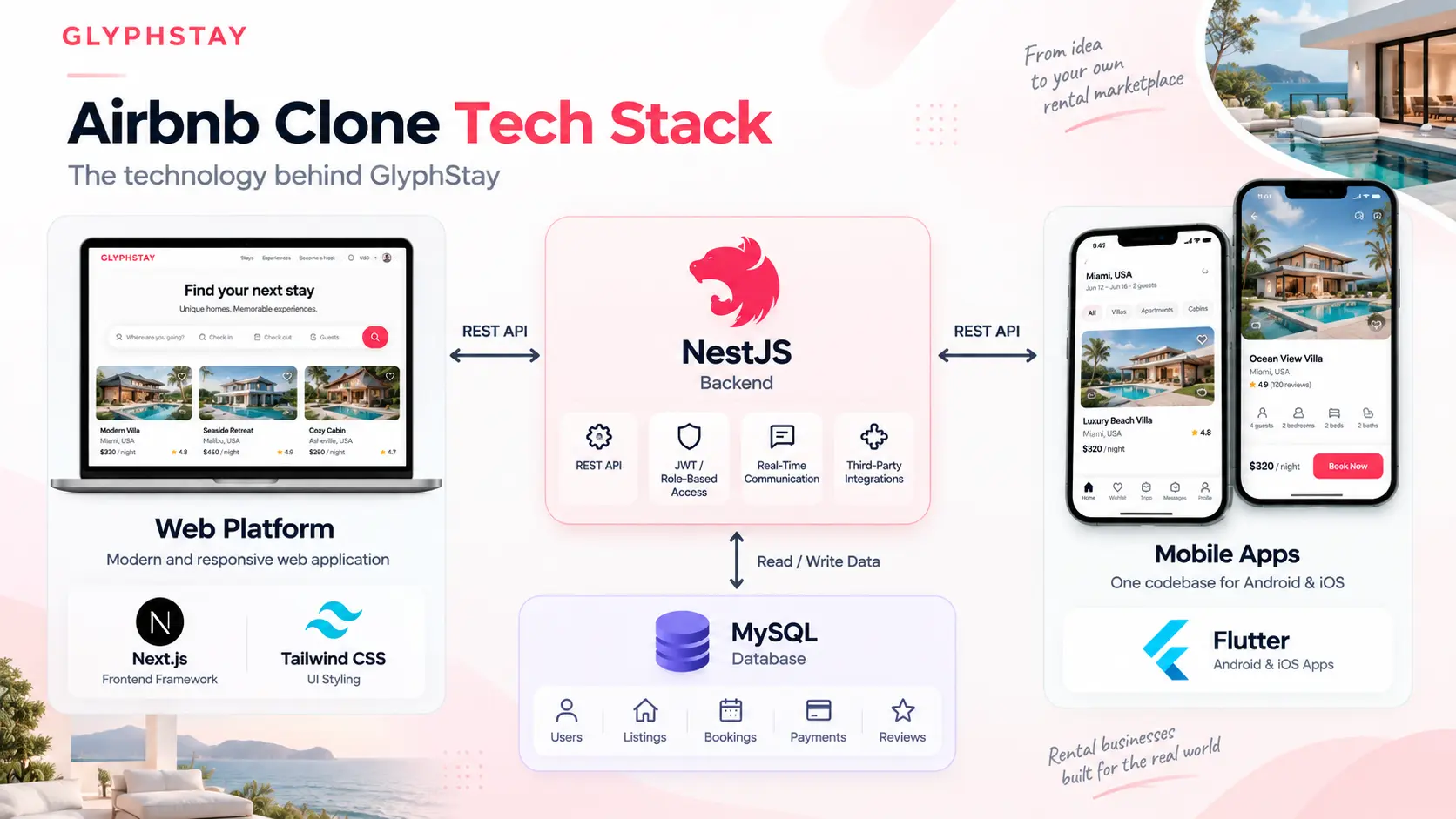
For GlyphStay, we use a JavaScript and TypeScript-based stack for the web and backend, MySQL for the database and Flutter for the mobile apps.
Here is how each part works.
Frontend: Next.js
We use Next.js for the GlyphStay web platform.
Next.js is built on React and is suitable for building modern web applications with multiple pages, user accounts and dynamic information.
In a vacation rental platform, the frontend handles what guests and hosts see and interact with.
For example:
Property search, listing pages, booking screens, user profiles, host management and other web pages are displayed through the frontend.
Next.js also gives developers a structured way to manage larger web applications as more pages and functionality are added.
UI: Tailwind CSS
We use Tailwind CSS for styling the web interface.
It helps developers work on page layouts, spacing, responsive design, buttons, forms and other interface elements.
For a white-label Airbnb clone, this is useful because customers normally want their own colors, branding and visual changes.
The design can be modified without changing the core booking functionality behind the platform.
Backend: NestJS
The backend is where most of the business logic happens.
GlyphStay uses NestJS for the backend.
For example, when a guest makes a booking, there is more happening than simply showing a confirmation page.
The backend needs to check information related to the user, property, availability, booking details, payment and other conditions.
NestJS helps us organize these backend functions into separate modules instead of putting everything together in one place.
This also makes it easier for developers to maintain different parts of the platform when new features are added.
Database: MySQL
We use MySQL as the main database.
We store information such as users, host profiles, properties, availability, bookings, payments, reviews and other platform information.
A rental marketplace deals with a lot of connected data.
For example: One booking can be connected to a guest, host, property, selected dates, payment and booking status.
A relational database such as MySQL works well for managing this type of structured information.
Mobile Apps: Flutter
For mobile apps, GlyphStay uses Flutter.
We love Flutter because it allow our developers to build the guest and host applications for both Android and iOS using a single codebase.
This does not mean that every part of Android and iOS development becomes automatic.
But maintaining one main Flutter project can reduce the amount of duplicate development compared with building two completely separate applications.
When a new feature is added, developers can also work on the Android and iOS versions from the same project.
For a vacation rental platform, mobile apps are very important because that’s where most of the bookings happen.
API: REST API
The web platform, mobile apps and backend need a way to communicate with each other right?
So, we use REST APIs for this.
For example, when the mobile app requests property information, the app sends a request to the backend API.
The backend gets the required information from the database and sends it back to the mobile app.
The same approach can be used for bookings, profiles, listings, reviews and many other functions.
Having a separate API layer is also useful when third-party services need to be connected later.
Authentication and Role-Based Access
GlyphStay uses token-based authentication with JWT, along with separate access permissions based on user roles.
This is important because a vacation rental marketplace normally has different types of users.
There are guests.
There are hosts.
And there are administrators.
Each user should only be able to access the functions available for their role.
For example, hosts need access to listing management, availability and booking information related to their properties.
Admin needs a completely different level of access to manage the entire platform.
Keeping these roles separate is an important part of the backend setup.
Real-Time Communication
Vacation rental platforms also have features where information needs to update quickly between users.
Messaging between guests and hosts is a good example.
For, real-time technologies we use Socket.io to maintain this communication between the frontend and backend.
This can also be useful for notifications and other features where users need to receive updates without manually refreshing the application.
How the Airbnb Clone Tech Stack works together?
Now let us put everything together.
When someone visits the GlyphStay web platform, they are using a frontend built with Next.js and Tailwind CSS.
If they are using the mobile application, they are using the Flutter app.
Both the web platform and mobile apps communicate with the NestJS backend through APIs.
The backend handles the main business logic and communicates with MySQL whenever information needs to be stored or retrieved.
For functions such as messaging, real-time communication can be handled separately using Socket.io.
So, rather than each application working independently, the web platform, mobile apps, backend and database are connected to the same system.
This is particularly important for a marketplace.
If a host changes property availability from one device, that information should also be available when a guest searches for the property from another device.
The technology behind the platform is what makes this possible.
Why should you check the Tech Stack before buying an Airbnb Clone?
Most people compare features when choosing an Airbnb clone.
There is nothing wrong with that.
You definitely need to check whether the platform supports the features required for your business.
But I would also recommend checking the technology before purchasing the product.
Ask what is used for the frontend, backend, database and mobile apps.
Check whether you receive complete source code.
Find out how the web and mobile apps communicate with the backend.
You should also check whether another developer can work on the source code if you decide to build custom features later.
This becomes more important when you are planning to use the platform for the long term.
A feature can always be added.
Changing the entire technical foundation later is usually a difficult job.
Takeaway
There is no single tech stack that every Airbnb clone has to use.
Different development teams may use different technologies depending on how their product is built.
What matters is whether those technologies work properly or not.
For GlyphStay, we use Next.js, NestJS, MySQL, Flutter and Tailwind CSS along with REST APIs, JWT authentication and real-time communication where required.
These are latest tech stack in the industry that gives stability and performance in the long run.
If you are planning to buy an Airbnb clone, do not look at the feature list alone.
Take a little time to understand what is behind the product as well.
It can make a big difference when you need to customize, maintain or expand your vacation rental platform later.
Want to see how GlyphStay works? Explore our Airbnb clone or contact us to discuss your vacation rental marketplace.