If you run a short-term rental business, AI is no longer a luxury.
People are already using AI every day to save time, get quick answers, write content, and make decisions.
As they become more used to this convenience, they may start expecting the same experience from the websites and mobile apps they use.
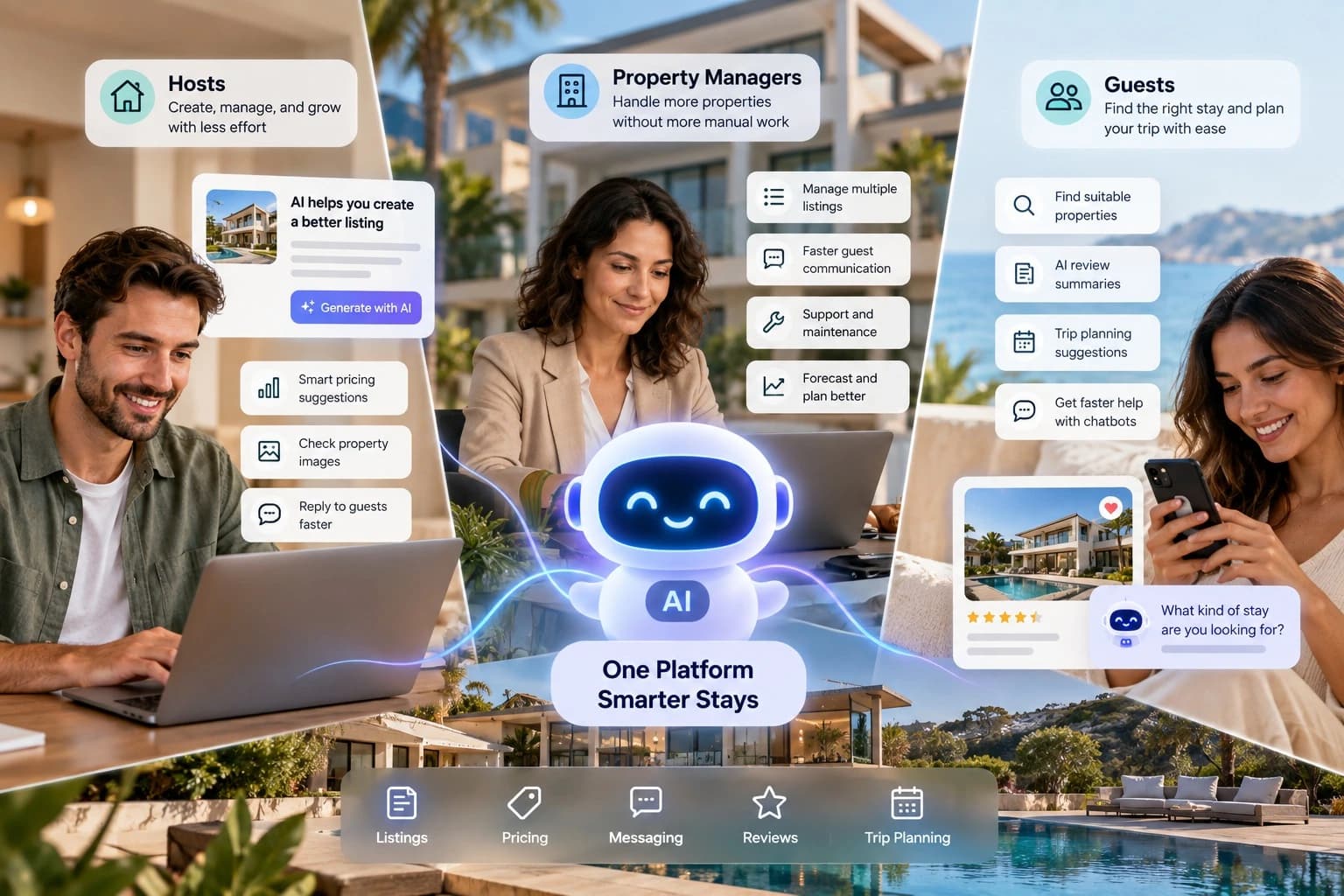
For a vacation rental platform, this means AI can help guests find the right property faster, help hosts manage listings and communication, and make everyday tasks easier for everyone.
By 2027, most hosts and property managers will not be asking whether AI is useful. They will be asking where it saves time, where it improves guest experience, and where it helps them run daily operations better.
That is the real shift, and you should not ignore it!
AI in short-term rentals is not just about chatbots or fancy automation. Do you know the most useful AI features are usually the ones that,
- reduce repetitive work
- help users make faster decisions and
- improve the overall booking experience.
In this blog, we will look at 10 practical AI use cases for hosts and property managers in 2027. Some of these are already built into GlyphStay, while others show where the market is moving next.
10 practical AI use cases for short-term rentals in 2027
1) AI listing generator
Writing a strong property title and description takes time.
Many hosts are not professional copywriters. Some keep their listings too short. Others add too much information without clearly showing what makes the property appealing.
An AI listing generator helps solve that problem.
In GlyphStay, hosts can use AI to generate a property title and description based on the listing details they provide.
For hosts who manage multiple properties, it saves a lot of their precious time. It also helps new hosts who may not know how to present their property properly from the start.
The main benefit here is speed and convenience. The host still reviews the result and make changes if needed before publishing.
2) Smart pricing suggestions
Pricing is one of the hardest parts of running a short-term rental business.
If the price is too high, bookings may slow down, and if it is too low, revenue is lost.
In GlyphStay, AI can suggest a nightly base price using market trends and location-based insights. The host can then review the suggested price and decide whether to use it.
This is useful because many hosts struggle to set the right price consistently. A suggestion engine gives them a starting point instead of guessing every time.
For property managers handling multiple listings, this can also reduce the time spent reviewing rates manually.
3) Smart messaging
Communication is a major part of short-term rental operations.
Hosts answer booking questions, check-in requests, availability questions, special requests, and post-booking messages.
Guests also often need help writing clear messages to hosts.
In GlyphStay, both guests and hosts can use AI to write personalized messages based on what they want to communicate. They can review and edit the message before sending it.
This is a very practical feature because it saves time without removing human control.
It is especially useful when,
- a guest wants to send a polite booking request
- a host wants to send a clear reply
- a property manager wants to respond faster during busy periods
4) AI review summary
Property reviews are helpful, but reading dozens of them can take time.
Guests often want a quick understanding of what previous visitors liked and what they did not.
In GlyphStay, AI can analyze property reviews and summarize the common positive and negative points mentioned by previous guests.
This gives future guests a faster way to understand the property.
For example, instead of reading 50 reviews one by one, a guest may quickly learn that,
- the location is frequently praised
- the property is clean
- parking is limited
- the Wi-Fi is good
- check-in is easy
This improves the decision-making process for guests and helps them book with more confidence.
5) AI trip planner
The booking journey should not stop once the reservation is complete.
Guests often want help planning what to do during their stay, especially if they are visiting a new place.
So, we have introduced the AI Trip Planner.
In GlyphStay, the AI Trip Planner becomes available after a booking is completed. It creates a day-by-day plan based on the location of the property and the length of the stay.
This makes the platform more helpful after the booking as well.
The goal here is to provide some extra value to guests. It is not necessary for hosts to manually prepare a local guide or recommendations every time.
Guests love this feature as it improves their travel experience.
For hosts, it can improve satisfaction and make the stay feel more complete.
6) Admin AI control center
Not every platform owner wants every AI feature enabled all the time and that is where admin-level control comes in.
In GlyphStay, admins can manage the available AI features from the admin panel and control which features are enabled or disabled on the platform.
This is important because different businesses have different needs and we know this from start.
One marketplace may want AI messaging and trip planning turned on. Another may prefer to keep only listing generation active.
This kind of control makes AI more practical for platform operators.
7) AI image detection
Property photos can make or break a booking.
Guests often decide whether to click on a listing based on the images and if the images are misleading, heavily edited, or AI-generated photos can quickly create trust issues.
If the real property looks different from what was shown online, it can lead to complaints, poor reviews, and unhappy guests.
That’s where AI image detection comes in!
AI image detection can help identify images that may have been generated using AI while a host is creating a listing. This gives the platform an extra layer of review before the property goes live.
In GlyphStay, uploaded property images can be checked to see whether they appear to be AI-generated.
During the uploading process, hosts will be notified with a warning about this and there are high chances that admin might not approve your listing.
AI detection is not always perfect, so it should work as an additional check rather than automatically deciding whether an image is genuine.
The goal here is to maintain quality listings with real images and reduce the risk of misleading property images.
8) AI chatbot
Guests and hosts often have simple questions while using a vacation rental platform.
Instead of waiting for support for every question, an AI chatbot can provide quick help directly inside the platform.
For example, a guest may want to know how Instant booking works, where to find their reservation, or how to contact a host. A host may need help understanding how to create a listing or manage availability.
An AI chatbot can handle these common questions and guide users to the right part of the platform.
More complicated issues can still be passed to the support team.
9) AI property search
Traditional vacation rental search normally depends on advanced filters such as location, bedrooms, price, amenities, and property type.
AI can make this easier by allowing guests to describe what they are looking for in normal language.
For example:
"I need a two-bedroom villa with a swimming pool that is suitable for a family in Goa."
AI can understand the request, compare it with available listings, and suggest properties that closely match the guest's needs.
It heavily reduces the amount of time guests spend adjusting filters and browsing listings that are not relevant to them.
For a large vacation rental marketplace, AI-assisted property search helps a lot to pick the right property for guests.
10) AI maintenance and issue management
Managing property issues can be a headache when you are handling multiple short-term rentals.
A guest may report that the air conditioner is not working, another may have a problem with the door lock, while another property may need cleaning before the next check-in.
When several requests come in at the same time, property managers need to understand which issue needs attention first.
AI can help by reading the guest's message, understanding the problem, and grouping it into categories such as,
- Cleaning
- Electrical issue
- Plumbing
- Check-in problem
- Appliance issue
- General maintenance
It can also help identify urgent problems that may need immediate attention.
AI can help property managers sort these requests faster instead of checking every message manually.
The final decision should still stay with the property manager, but AI can make their work easier by identifying the problem and categorize it accordingly.