Building a website for one vacation rental owner is fairly straightforward.
You have properties, availability, pricing and a booking process.
A multi-host vacation rental platform is different.
Now you have independent property owners operating inside the same marketplace. Each host needs control over their own listings, availability, reservations and earnings, while the marketplace operator needs visibility and control across the entire platform.
That changes how you need to think about the product.
The difficult part is not simply allowing multiple people to create listings. The real work is making sure that every listing, calendar, booking, payment, cancellation and payout belongs to the correct host without creating conflicts between users.
This guide explains how that model should be planned and built.
A multi-host vacation rental platform is an online marketplace where multiple independent property owners can create accounts, publish listings, manage their availability, accept reservations and receive earnings through one platform.
Guests can search properties from different hosts and complete their booking through the same website or app.
The marketplace operator (admin) manages the entire platform, including users, listings, reservations, service fees, payments and platform settings.
Airbnb is one fine example of this marketplace structure but the same model can be used for other rental platforms, luxury villas, cabins, apartments, farm stays and other specialised rental businesses.
These two models can look similar to the guest, but they work very differently behind the scenes.
| Area | Single-Owner Website | Multi-Host Marketplace |
|---|
| Property ownership | One business | Multiple independent hosts |
| Listings | Managed centrally | Managed by each host |
| Availability | Controlled by one operator | Separate calendar for every listing |
| Payments | Usually go to one business | May require marketplace fees and host payouts |
| User roles | Mostly guests and admin | Guests, hosts and administrators |
| Earnings | Belong to one company | Need to be tracked by host |
| Admin role | Manages own inventory | Oversees the entire marketplace |
| Moderation | Limited | Hosts and listings may require review |
| Disputes | Business vs customer | Guest, host and platform can all be involved |
This distinction matters early.
If you are building the website for one property company, turning it into a multi-host marketplace later is a pretty complex task. So understand what you need before starting the development.
How does the Multi-Host model work?
There are normally three main sides to the platform.
Guest
The guest searches available properties, checks listing information, selects dates and completes a booking.
Depending on the marketplace model, the guest may book instantly or send a request that the host needs to approve.
Host
The host creates and manages their own properties.
A host may need to,
- Add and edit listings
- Upload property photos
- Set amenities and house rules
- Set pricing
- Block unavailable dates
- Review reservations
- Accept or reject booking requests
- Manage cancellation settings
- Check earnings and payouts
Marketplace Admin
The admin operates the entire marketplace rather than an individual property.
The admin may need control over,
- Hosts and guests
- Property listings
- Reservations
- Service fees
- Transactions
- Refunds
- Platform settings
- Listing or account moderation
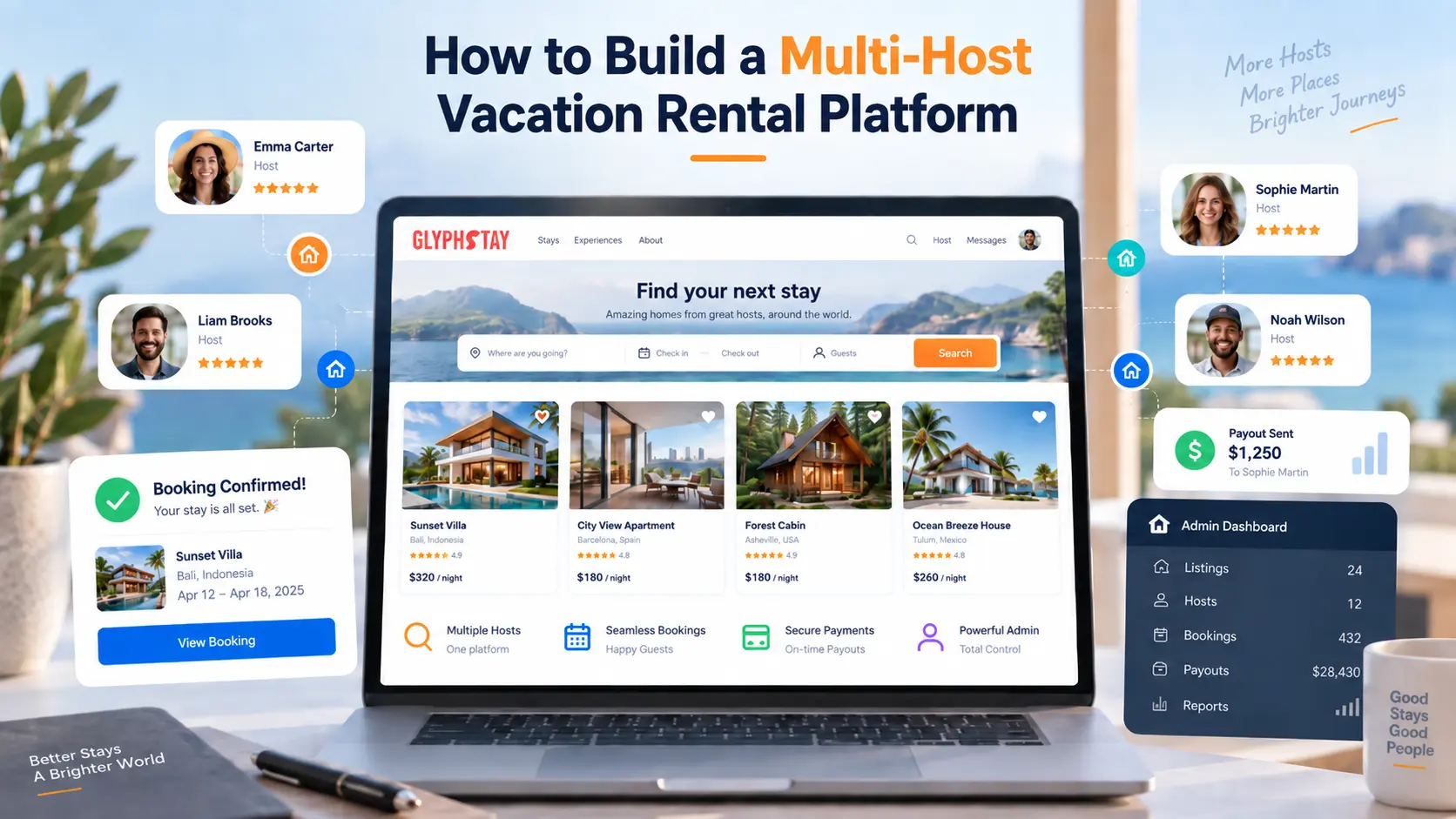
GlyphStay Airbnb clone currently follows this guest, host, and admin structure.
It has host features such as listing management, calendars, Instant Booking and Request to Book, payouts, seasonal pricing and cancellation policies.
Admin panel can manage users, listings, bookings, platform fees, and overall management.
Start with marketplace rules and not just screens
The most common mistake people make is starting with homepage design or mobile screens before deciding how the marketplace actually works.
You first need business rules.
For example,
- Can anyone register as a host, or does an admin needs to approve them?
- Can a host publish a listing immediately?
- Does every property require admin approval before publishing?
- Can one host own ten or more properties?
- Can one user be both a guest and a host?
- Can hosts choose between Instant Book and Request to Book?
- Who decides cancellation rules?
- When does the host receive the payout?
- Does the marketplace charge the guest, the host, or both?
These decisions affect your database, APIs, payment integration, and user interface.
Changing them halfway through development usually creates unnecessary work. So decide what you want first.
Define Roles and Permissions
Role-based access is one of the most important parts of a multi-host marketplace.
A host should not be able to edit another host's property simply because they know its listing ID.
The same rule applies to reservations, messages, earnings, payout details and calendars.
Permissions therefore need to exist in the backend, not only in the interface.
A simple example would be:
- Guest: Can manage their own profile, wishlists, bookings and messages.
- Host: Can manage their own profile, properties, calendars, reservations and payout information.
- Admin: Can manage marketplace-level information across users, listings and reservations.
GlyphStay currently have role-based access for guests, hosts, and admins within its technology architecture.
Give more importance to Availability Calendar
Calendars should not be treated as a decorative host feature.
They are part of the booking engine.
A guest searching from October 10 to October 14 should only see properties that can actually accept that stay.
Once a valid booking is confirmed, those dates should no longer be available for another incompatible reservation.
This is very important logic you need to implement.
Hosts also should have an option to block dates manually. Also, hosts should have an option to apply special prices for weekends, festivals, etc
Airbnb's own host documentation, for example, lets hosts mark individual nights as available or blocked in the listing calendar.
For a multi-host marketplace, each listing needs its own availability state.
This becomes more important as the marketplace grows because many hosts may be changing calendars and receiving bookings at the same time.
Understand the Booking Status
A booking is rarely just "booked" or "not booked."
You may need states such as:
- Requested → Accepted → Paid → Confirmed → Completed
- Requested → Declined
- Confirmed → Cancelled → Refunded
The exact workflow depends on the business model.
What matters is that each state has clear rules.
For example,
- If a host declines a booking request, should the dates remain available?
- If a guest cancels, when should availability reopen?
- If payment fails after a host accepts the request, does the reservation remain temporarily held?
These cases should be addressed before you begin the development.
Payments are different in a Marketplace
Payments work differently in a vacation rental marketplace compared with a normal online store.
In a regular online store, the business usually keeps the full payment.
In a marketplace, the guest pays for the booking, but part of that money may need to go to the host.
For example, if a guest pays $1,000 for a booking, the platform may keep a service fee and the remaining amount goes to the host.
So the payment system needs to handle more than just checkout. It should also keep track of,
- How much the guest paid
- How much the platform earned as a service fee
- How much the host should receive
- Any refunds
- Whether the host payout has been completed
Payment services such as Stripe Connect and PayPal are built for this type of marketplace setup because they can help collect payments, deduct platform fees and send the remaining amount to hosts.
The important part is to keep every transaction clear and precise.
Keep Booking and Payout Status Separate
Payment from the guest and payout to the host are two different events.
A reservation can be fully paid by the guest while the host payout is still pending.
Likewise, a refund or cancellation can affect the amount eventually payable to the host.
Airbnb's own payout documentation shows how host payouts can differ from the guest's total booking price because service fees and other payout adjustments may apply.
Your platform should therefore avoid storing everything under one generic payment_status.
Booking payment, refund and host payout should each have their own status.
That makes financial operations much easier to understand.
Let Hosts manage their business while Admin keeps control
Hosts need enough control to run their rental business.
They should not need the marketplace administrator to change a price or block a date.
At the same time, the administrator still needs marketplace-level authority.
For example:
- Hosts can publish properties but the admin should have access to unpublish a listing that violates marketplace rules.
- Hosts may choose their pricing, while the admin controls the marketplace service fee.
- Hosts manage reservations related to their listings, while the admin needs visibility into reservations across every host.
The objective is not to give either side unlimited access.
It is to define exactly what belongs to the host and what belongs to the platform.
Build Admin Operations Early
Founders often spend most of their attention on the guest application.
It is completely okay because guests generate bookings.
But multi-host marketplaces create operational work behind the scenes.
Someone may eventually need to,
- Review a suspicious listing.
- Disable a host account.
- Check why a reservation failed.
- Issue or verify a refund.
- Review a payment.
- Change a marketplace fee.
- Unpublish a property.
- Check the history of a booking.
Without a proper admin system, these simple operational tasks turn into database requests for the development team.
That is not a good way to run a marketplace. So build the admin panel first and then focus on guests and hosts.
You decide your Service Fee Model
Multi-host marketplaces need a clear way to make money.
A booking service fee is one common option.
The marketplace can potentially charge:
Host fee: A percentage or fixed amount deducted from host earnings.
Guest fee: An additional fee included in the guest's checkout price as a marketpalce service fee.
Both sides: A portion charged to the host and another portion charged to the guest for using the platform.
Your booking system should calculate these amounts consistently and store them with the reservation.
Do not calculate old transactions again using the platform's current fee percentage.
If your commission changes from 10% to 12% next year, a booking from this year should still show the original fee that applied when it was created.
This is a small architectural decision that prevents major accounting confusion later.
Plan more on Cancellations and Refunds
A multi-host marketplace needs to answer more than "Can a guest cancel?"
It needs to define,
- Who sets the cancellation policy?
- Can different hosts choose different policies?
- What happens to the platform fee?
- What happens if the host cancels?
- Can an admin override the normal cancellation process?
- When should blocked dates become available again?
- How is the host payout adjusted?
These rules should be connected to the booking state, refund status and payout calculation.
Otherwise, cancellations can become one of the hardest areas to maintain.
Test Multi-Host edge cases
Testing one perfect booking is not enough.
Try situations such as,
- Two guests attempting to reserve the same property for the same dates.
- A host changing the price while a guest is checking out.
- A host becoming suspended while future bookings still exist.
- A refund being requested after a host payout has been prepared.
- A property being unpublished with upcoming reservations.
- A user switching between guest and host roles.
- A host managing several properties with different calendars and cancellation settings.
- A payment succeeding while the booking confirmation request times out.
These are the situations that expose marketplace problems before customers do. Test it thoroughly before you go live.
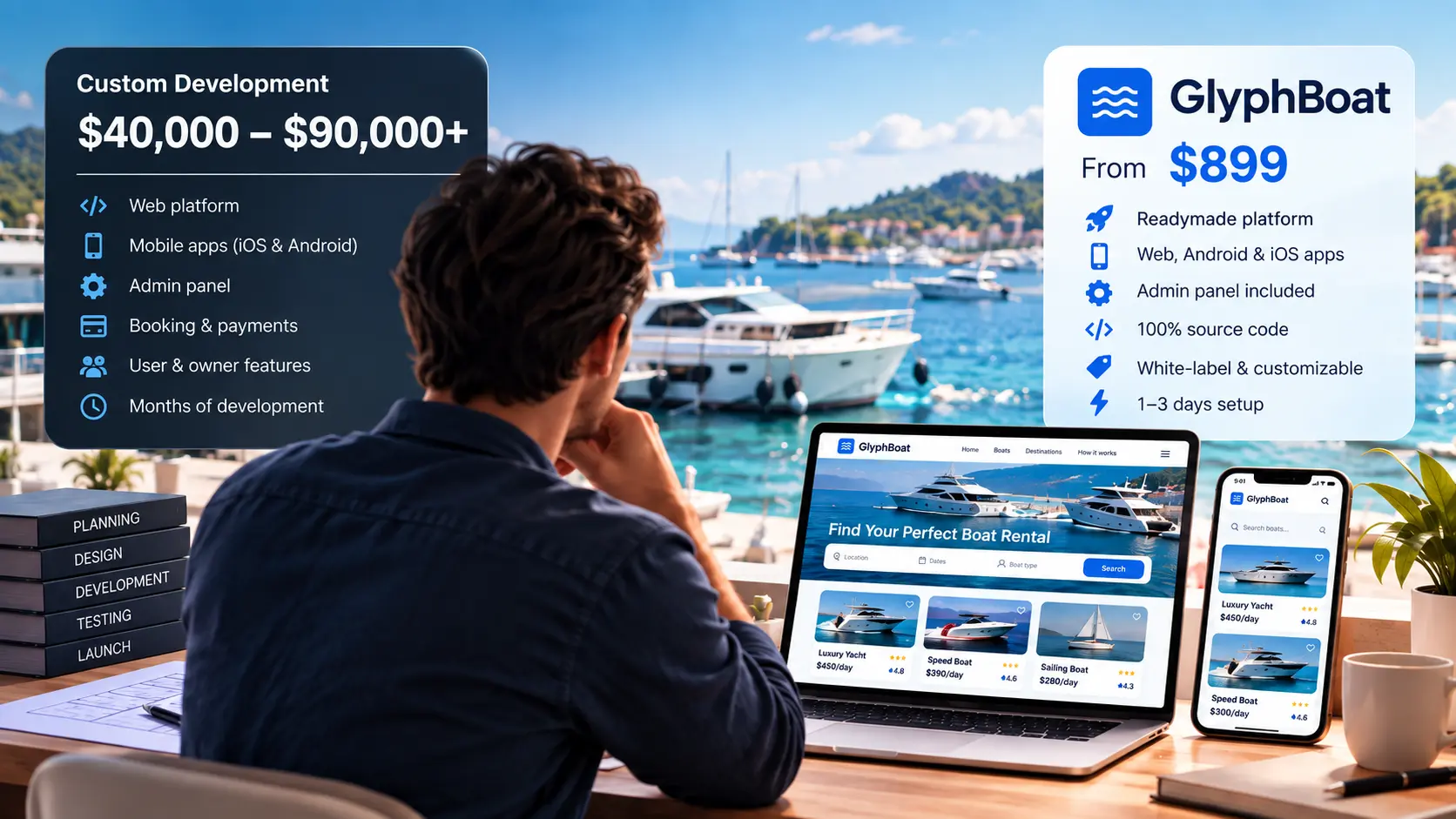
Because, platform’s like GlyphStay has gone through all these type of testings with a dedicated QA team. It’s a better choice to choose a readymade solution like GlyphStay Airbnb clone instead of developing a multi-host vacation rental platform from scratch
There are three broad approaches.
| Approach | Best suited for | Main consideration |
|---|
| Custom development | Highly specific marketplace requirements | Maximum control but more time and development work |
| Marketplace/no-code platform | Testing a marketplace concept | Faster setup but platform limitations may matter later |
| Ready-made vacation rental software | Businesses wanting existing guest, host and admin workflows | Confirm customization, ownership and architecture before purchasing |
The right choice depends on how unusual your business rules are.
If your model requires completely new workflows, custom development may make sense.
If you primarily need established vacation-rental marketplace functionality and then want to customize it around your brand and market, starting from an existing platform like GlyphStay can save time and money.
If you do not want to build the guest, host and admin architecture from zero or scratch, GlyphStay is the great option to look into.
GlyphStay is a readymade vacation rental marketplace platform that helped 50+ vacation rental owners to launch their platform.
Its comes with a web platform, admin panel, Flutter mobile apps for guests and hosts, and complete source code.
Hosts can manage listings, availability, booking types, payouts, seasonal pricing and cancellation policies.
Admin can manage users, listings, bookings, service fees and other platform settings.
GlyphStay Airbnb clone is built with:
- Next.js for the web platform
- NestJS for the backend,
- MySQL for data storage,
- Flutter for Android and iOS apps
- Tailwind CSS for the interface
- REST APIs connect the different parts of the system
With GlyphStay, you can go live (launch your platform) in 1-3 days with your own brand name, logo and colors.
Of Course, some features may require custom work but that can be handled parallely. With custom features, you can go live within 1 to 2 weeks.
For a multi-host business, guest, host and admin panel will give you an additional advantage and it is recommend to go with pre-built solution instead of developing everything from start.
What should you build first?
Do not try to copy every function found on Airbnb. Start with the transaction.
A host needs to be able to publish a bookable property.
A guest needs to be able to find it.
The calendar needs to return accurate availability.
The guest needs to be able to reserve it.
The platform needs to know who owns the booking.
Payment and service fees need to be recorded correctly.
The host needs to know what they earned.
The administrator needs to be able to see what happened.
Once that complete loop works perfectly fine, additional features become much easier to prioritise.
That is the foundation of a multi-host vacation rental platform.