A vacation rental marketplace can look very simple from the outside.
Host lists a property -> Guest books a stay -> Platform earns a fee.
That is how most people understand the model at first.
The problem is that building the platform is not the hard part.
The difficult part is managing everything that happens between the host and guest.
Availability has to be accurate.
Payments need to be handled properly.
Both sides need to trust each other.
Cancellations, reviews, messages, and disputes also need to be managed.
We all know this flow. The host owns or manages the property. The guest needs somewhere to stay. The platform connects both sides and gives them the tools needed to complete the booking.
That is the basic idea behind peer-to-peer vacation rentals.
The interesting part is that the platform does not need to own the properties being rented.
Its job is to make it easier for two people who may have never met before to find each other, communicate, book, pay, and complete the stay.
If you are planning to start your own vacation rental marketplace, understanding this relationship is more important than simply thinking about listings and bookings.
What is a peer-to-peer vacation rental marketplace?
A peer-to-peer vacation rental marketplace connects property owners who want to rent out their place with travelers looking for somewhere to stay.
There are usually three parties involved,
- Host: Provides the property.
- Guest: Books and stays at the property.
- Marketplace: Connects both guests and hosts and manages the online transaction for a small commission.
You need to understand that the host may be someone renting a spare room, an owner with a holiday home, or even a professional property manager handling several properties.
The important part is that the marketplace itself does not need to own that accommodation.
Airbnb has previously described this structure as a "people-to-people marketplace" or two-sided platform, where hosts provide the supply and travelers create the demand.
How is this different from running your own rental website?
This is where people sometimes get confused.
Imagine you own five holiday villas in Goa.
You create a website and allow travelers to book those five villas.
That is a vacation rental booking business, and it is not really a peer-to-peer marketplace.
Your company controls the entire property supply.
Now imagine you create a platform where property owners across Goa can register and list their own villas.
Guests come to your platform and compare properties from different owners and book one.
That is a rental marketplace platform.
The difference is who provides the inventory.
| Model | Who provides the properties? | Who manages the marketplace? |
|---|
| Single rental business | One business | Same business |
| Property management company | Properties managed for different owners | Property manager |
| P2P marketplace | Independent hosts or property managers | Marketplace operator |
A marketplace therefore grows differently from a normal rental business. You are not only trying to get bookings. You are trying to attract both properties and travelers.
Note: You can still own properties yourself and run a peer-to-peer marketplace. For example, you may own five villas in Goa and list them on your platform, while also allowing other hosts to register and add their own properties. In that case, you are both a host and the marketplace owner.
How does the peer-to-peer vacation rental model work?
Alright! Let’s dig deep into this. The complete process usually starts with the host.
1) A host joins the marketplace
A property owner creates an account and decides to list a property.
To list, hosts have to add details like property type, location, photos, amenities, house rules, available dates, and price.
The host is creating the supply side of the marketplace.
If there are only a few properties on the platform, guests have fewer options to choose from and may leave without booking.
2) A guest searches for a stay
The guest arrives with a different goal.
They may search for,
"2-bedroom villa in Goa from December 20 to 24."
The platform then needs to show suitable properties that are available for those dates.
The guest will compare photos, prices, amenities, locations, host information, and previous reviews before choosing where to stay.
This is the demand side of the marketplace.
This is one of the biggest jobs of the marketplace.
It is not about having hundreds or thousands of listings. Those listings need to be searchable and useful.
If someone searches for a beachfront villa for six people, showing them studio apartments 20 kilometres away does not make sense.
So, features like search, filters, maps, availability, pricing, and recommendations should help guests to find the right property.
4) The guest makes a booking
Once a guest finds a property they like, they select their stay dates and proceed with the booking.
Depending on how the marketplace works, the reservation might be confirmed immediately or sent to the host for approval.
Both approaches are used in the vacation rental industry. Airbnb, for example, currently supports both Instant Book and request to book options depending on the listing.
Once the booking is confirmed, the platform saves the guest details, property, stay dates, and booking amount.
5) Payment goes through the marketplace
This is another important part of the P2P model.
We all know that the guest is booking a property owned by somebody else, but the marketplace may still handle the booking and payment process.
Imagine the total booking is $500.
Now, the guest pays $500 through the platform.
Depending on the marketplace's fee structure (either fixed or percentage based), a portion may be kept as the platform fee and the remaining amount becomes payable to the host.
For example:
- Guest payment: $500
- Platform fee: $50
- Host earning: $450
This is only a simple example. The actual fee structure depends on how the marketplace owner wants the business to work. A marketplace can charge the host, the guest, or both, depending on its fee structure.
Current large vacation rental marketplaces also separate what the guest pays from what the host eventually receives.
6) The stay takes place
Once the booking is confirmed, the host is fully responsible for providing the accommodation.
The guest and host may communicate about arrival time, check-in instructions, property access, or other questions via an in-app messaging system.
The marketplace still has a role here.
If something goes wrong with the reservation, someone needs to handle cancellations, refunds, complaints, or disputes.
The platform therefore sits between both sides even though it does not physically provide the accommodation.
7) The booking creates trust for the next guest
After the stay, reviews and ratings become important.
A new guest may not know anything about the host.
But if previous guests have stayed there and shared their experience, that will be very helpful for new guests to make a decision to whether to book the property or not.
The same idea can apply to host profiles and guest profiles.
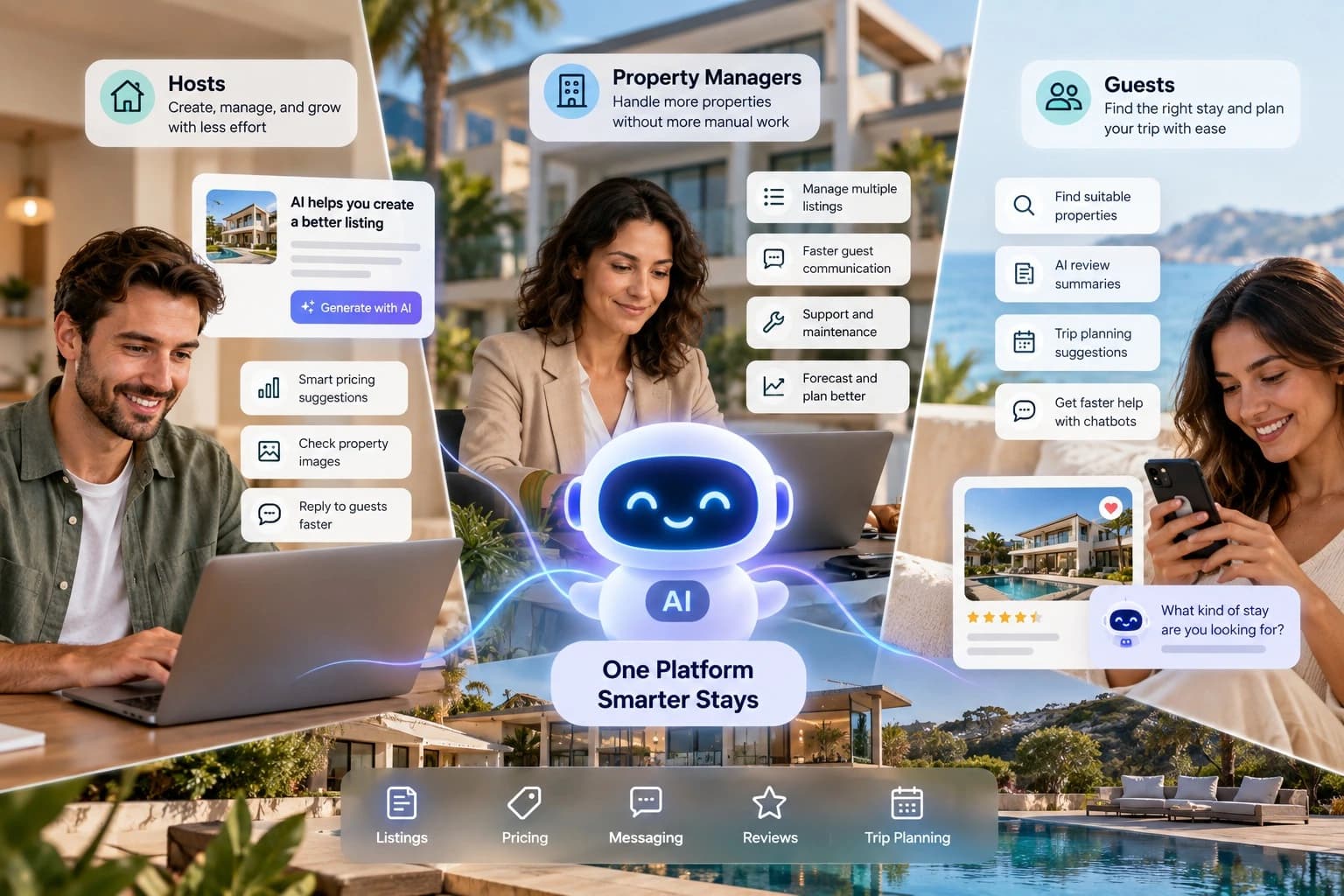
With a platform like GlyphStay, hosts can use AI review summaries to understand what guests liked and where their property could improve.
Using that information, hosts can improve the experience.
What is the marketplace actually providing?
The most common mistake people do is, “thinking the marketplace is selling accommodation”.
No it is not! And not in the same way a hotel does.
The host is the one who provides the accommodation and not the marketplace.
The marketplace provides the connection and the system around the transaction.
Like,
- helping guests discover properties,
- checking availability,
- processing bookings,
- supporting payments,
- allowing communication,
- collecting reviews, and
- giving the platform owner control over what happens inside the marketplace.
Technology is important, but the marketplace model matters more.
A good-looking website alone will not make the business work.
Trust is a bigger problem in P2P rentals
Think about what the guest is being asked to do.
They may be sending money to book a property owned by someone they have never met, in a city they have never visited.
The host has a similar problem.
They are allowing someone they do not know to stay in their property.
That means trust cannot be treated as an extra feature, right?
The goal of the platform is to build trust and reduce uncertainty.
Features like profiles, reviews, property information, secure payments, messaging, clear cancellation rules, and account verification can help reduce uncertainty.
For example, Airbnb currently requires primary hosts, new co-hosts, and booking guests to complete identity verification.
Because Airbnb knows that verification helps reduce fraudulent behaviour but does not guarantee that every user is genuine.
That last point matters for anyone building a marketplace.
No single feature completely solves trust. You normally need several checks working together.
The hardest part is getting both sides of the marketplace
This is one of the biggest differences between starting a marketplace and starting a normal vacation rental business.
Suppose you launch with 200 properties but almost no guests.
Hosts join, wait for bookings, get nothing, and eventually stop paying attention to the platform.
Now imagine the opposite.
You attract plenty of travelers, but only have ten properties available.
Guests search, find very few suitable options, and leave.
This is the classic problem of a two-sided marketplace.
Hosts need guests. Guests need hosts.
One side becomes more valuable when the other side is active.
That is why a new P2P vacation rental marketplace usually needs a clear starting point.
Instead of trying to cover every country and every type of property on day one, focus on a niche location, property type, and traveler group.
The goal is not to have the biggest marketplace immediately. The goal is to make the marketplace useful in the area you choose first.
How does a P2P vacation rental marketplace make money?
We all know that, as a platform owner, you do not have to own the properties to make money.
You earn when a booking happens through your platform.
For every booking, you can charge a fixed or percentage-based service fee from both hosts and guests.
For example, if a guest books a property for $500, you can keep a small percentage as your platform fee and send the remaining amount to the host.
You can also add other revenue options later, such as featured listings, host subscriptions, or paid promotions.
Where can the P2P model go wrong?
The model sounds attractive because the platform can grow without buying hundreds of properties.
But that does not mean it runs itself.
Problems usually start when one side of the marketplace has a bad experience.
For example,
A host may leave because bookings are too low.
A guest may leave because the properties shown are poor quality.
A guest may book a property that is actually unavailable because the calendar was not updated.
A host may become frustrated because they do not understand their payout.
A misleading listing can damage trust far beyond one reservation.
A cancellation that was not handled properly can cost both guests and hosts.
These problems are why marketplace operations matter just as much as attracting new users. Focus on the operations and experience before you focus on marketing or revenue.
A good question!
They are closely related but the terms describe slightly different things.
Peer-to-peer describes the business model. One group provides something and another group rents or uses it through the marketplace.
Multi-host describes the platform structure. Many hosts can manage their own listings inside the same system.
For a vacation rental marketplace, the two usually work together.
If you want to know how things work when many hosts use the same platform, this multi-host vacation rental guide can help you. It explains how listings, calendars, bookings, payouts, and admin controls in more detail.
Where does GlyphStay fit into this model?
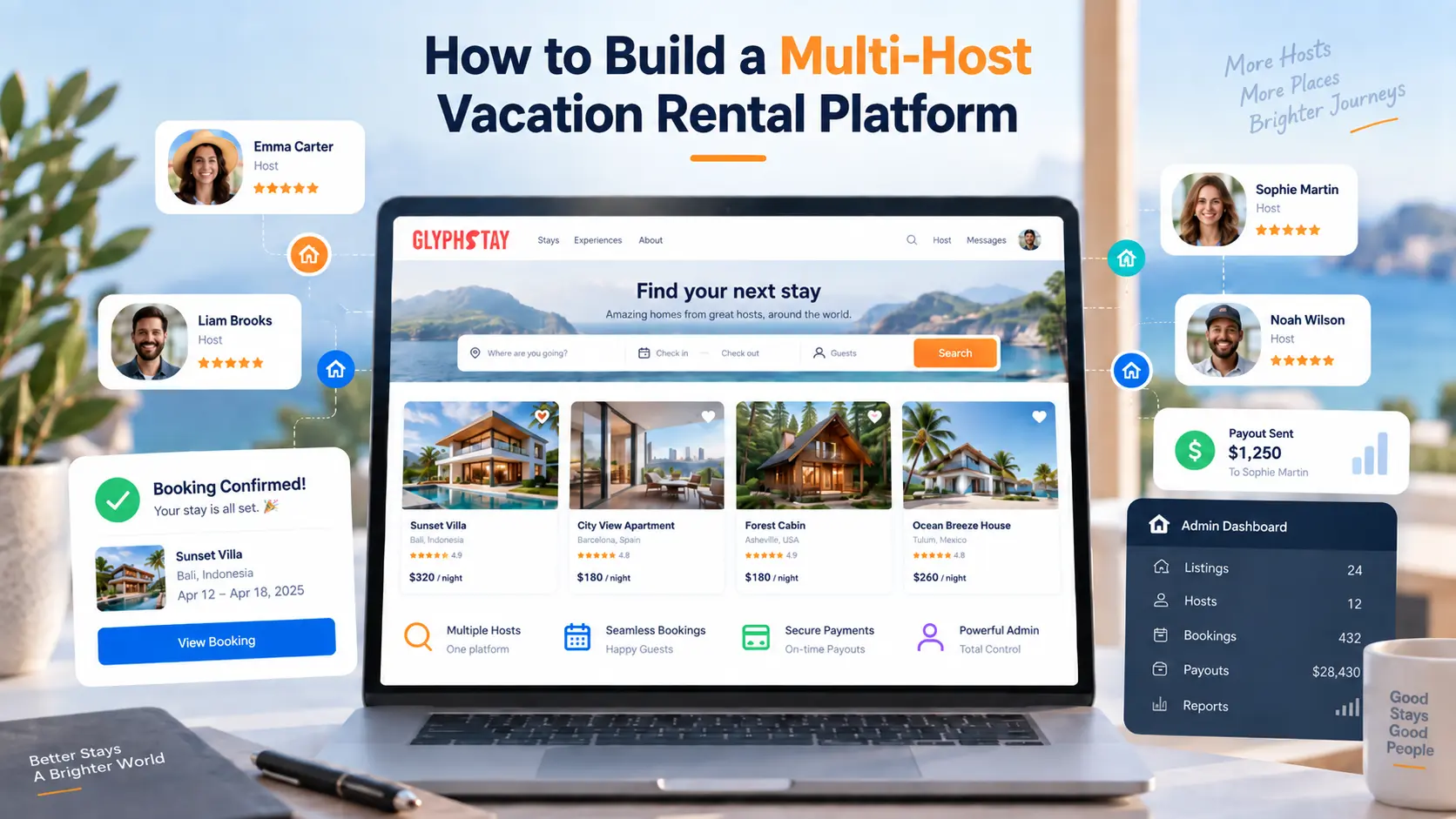
GlyphStay follows the same marketplace model we discussed above - guest, host, and admin.
Hosts can add properties, manage pricing, availability, bookings, and payouts.
Guests can search for properties, check details, make bookings, pay, message hosts, and leave reviews.
The admin can manage users, listings, bookings, service fees, payments, and other platform settings.
So, if you want to start your own peer-to-peer vacation rental marketplace, GlyphStay’s vacation rental marketplace platform can give you a starting point.
It comes with guest panel, host panel, booking workflows, admin panel, mobile apps along with built-in AI features. With GlyphStay setup, you don’t have to build a vacation rental marketplace from scratch.
But before adding more features, you need to understand about your
- business model
- target location
- type of hosts
- target audience (guests)
- commission structure
- booking rules and
- platform policies
Is the peer-to-peer model right for every vacation rental business?
The answer is “No”.
If you own all the properties yourself and only want guests to book your own inventory, a marketplace may add complexity that you do not need.
The P2P model makes more sense when the business is built around bringing independent property supply onto one platform.
It is particularly relevant when you want different owners or property managers to manage their own listings while your business operates the marketplace connecting them with travelers.
That distinction should be clear before you make a decision.
Takeaway
A peer-to-peer vacation rental marketplace is not simply a website filled with properties.
It is a business built between two sides.
Hosts bring properties. Guests bring demand. The marketplace needs to make it easy and safe for those two groups to find each other and complete a booking.
Get that relationship right and the platform can grow without owning every property listed on it.
If you are planning to launch this type of business, you can explore GlyphStay's vacation rental marketplace platform or contact Glyphstergo to discuss how you want your host and guest marketplace to work.