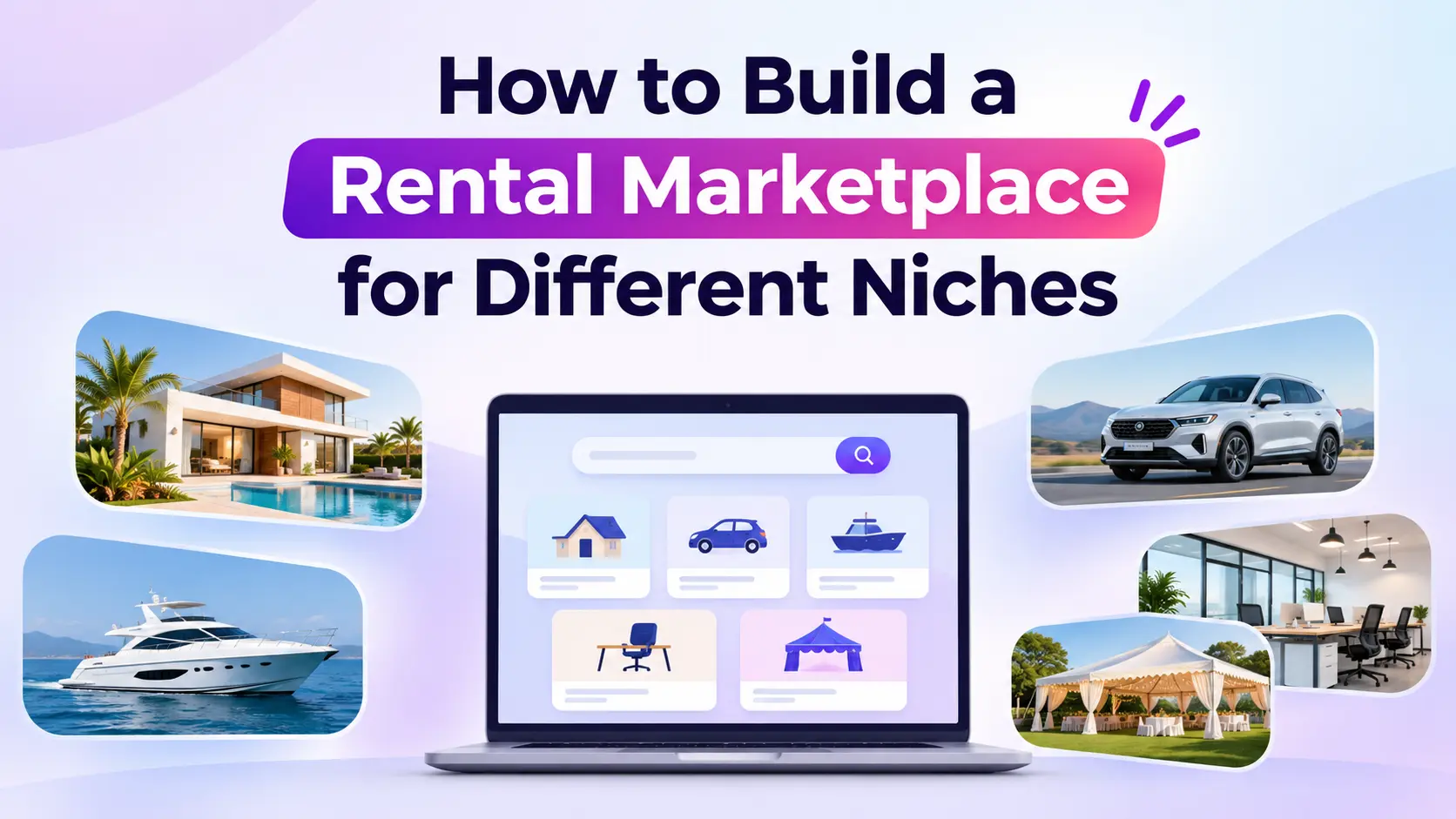
Everyone has a business idea and let’s say you wish to start a rental marketplace platform
The idea is fine but the real challenge starts when you try to turn that idea into a working platform especially for different niches.
A vacation rental business needs check-in and check-out dates.
A boat rental should have both all-day and hourly bookings along with captain options.
A car rental needs pickup details. Equipment rentals may need deposits, quantities, and return tracking.
So different rental marketplaces have different use cases.
If you use the same booking flow for every rental business, you may end up spending more time on altering the platform later.
The better approach is to start with a common rental marketplace foundation. You can change the parts depending on what people are renting.
Let’s discuss the use case in detail.
After reading this blog, you will understand what usually stays the same across rental marketplaces and what needs to change for each niche and also how to choose the right software.
What is rental marketplace software?
Rental marketplace software is a platform that connects people who have something to rent with people looking to rent it. In simple terms, it connects owners and renters in one platform.
The marketplace owner manages both the platform and the users who are using the platform.
Providers add whatever they want to rent. It can be a property, boat, car, venue, or even a piece of equipment.
Customers on the other end can search the available listings and make a booking.
The platform sits between both sides and helps manage the transaction and takes a part of the commission for it.
It is not like a traditional rental business where the marketplace owner need to own something. No!
In a rental marketplace, the platform owner doesn’t have to own anything.
For example, if you run a boat rental marketplace, you don’t have to own a boat. Boat owners can add their boats while customers (renters) book them through your platform.
Features that remain the same in rental marketplaces
The type of rental may change, but several parts of the platform usually stay the same.
| Common feature | What it does |
|---|
| User accounts | Gives owners and renters their own access |
| Listings | Allows providers to add what they want to rent |
| Search and filters | Helps customers find suitable listings |
| Availability | Shows when something can be booked |
| Booking system | Handles rental requests or instant bookings |
| Payments | Collects payment for the booking |
| Messaging | Allows both guests and hosts to communicate with each other |
| Reviews | Helps future customers understand previous experiences |
| Admin panel | Gives the platform owner control over users, listings, bookings, and fees |
This is why it is possible to use an existing marketplace for different rental businesses.
You can use GlyphStay Airbnb clone to launch your rental marketplace or customize it for any type of niche rental business.
But the platform should not stop there.
The next question is more important:
What exactly are people renting?
This is the most important answer you need to find out.
Then you can decide how the rest of the platform should work.
What changes for each rental business?
This is where one rental marketplace starts to look very different from another.
Let's take a few examples.
1) Vacation rental marketplace
A vacation rental marketplace connects hosts with the guests who are looking for somewhere to stay.
The booking is normally based on nights.
A guest chooses,
Check-in date -> Check-out date -> Number of guests
The host needs to manage property availability, nightly pricing, house rules, amenities, cancellation policies, and reservations.
You should have options such as Instant Book or Request to Book.
The listing itself is heavily focused on the property.
Guests want to know about bedrooms, bathrooms, amenities, location, property rules, photos, and previous reviews.
So even though the core platform uses listings and bookings, it needs to understand how accommodation works.
GlyphStay is our vacation rental marketplace platform built around this type of guest, host, booking, and admin workflow.
2) Boat rental marketplace
Now change the property into a boat.
The marketplace still has,
- Owners
- Renters
- Listings
- Availability
- Bookings
- Payments
But the information people need is different.
A renter like to know the boat type, passenger capacity, length, location, available equipment, captain availability, etc.
The booking is either hourly or daily rather than nightly.
For example,
A guest may rent a villa from Friday to Sunday.
A boat renter may want the boat from 10 AM to 4 PM on Saturday.
That means the availability calendar and pricing system need to be changed completely.
You may also want the owner to choose whether the boat is offered with a captain, without one, or both.
So changing the word "property" to "boat" throughout the platform alone is not enough.
The entire booking flow needs to fit boat rentals.
Our boat rental marketplace is built around boat owners, renters, availability, and the booking flow for a boat rental platform.
3) Car rental marketplace
Cars bring another set of requirements.
A customer is not choosing bedrooms or amenities here.
They are looking at,
- Vehicle make and model
- Seats
- Fuel type
- Transmission
- Pickup location
- Rental period
- Daily or hourly price
- Vehicle availability
A peer-to-peer marketplace may allow different car owners to list their vehicles.
A fleet-based business may own the vehicles itself.
Some businesses may even combine both models.
The booking flow should consider where and how the vehicle is handed over.
i) Will the renter collect it from the owner?
ii) Will it be delivered?
iii) Does it need to be returned to the same place?
iv) Does it include any security deposit?
These are business rules that a vacation rental platform normally does not need.
So while the marketplace structure is similar, a car rental marketplace needs a booking flow designed around vehicles.
4) Space and venue rental marketplace
Now imagine the same model for studios, meeting rooms, party halls, rooftops, sports spaces, or wedding venues.
Again, the platform still needs listings, search, bookings, and payments.
But the renter is looking for very different information.
For a venue, things like capacity become important.
A customer needs to know about,
- A meeting room for 10 people for three hours.
- A photography studio for half a day.
- A wedding venue for 300 guests for an entire evening.
This makes hourly availability much more important.
Venue rules can also be different.
- Can customers bring outside food?
- Are events allowed after a certain time?
- Is parking available?
- What is the maximum capacity?
These details need to be part of the listing and booking process.
GlyphSpace - check our space rental marketplace that follows this type of host and renter model.
5) Equipment rental marketplace
Equipment is another good example of why one workflow does not fit every rental business.
Example: Imagine somebody renting,
- A camera
- A power tool
- Construction equipment
- Camping gear
- Event equipment
The marketplace should tell the users how many units are available, the condition of the equipment, pickup or delivery options, and whether a deposit is required or not.
Availability can also work differently.
A property is normally booked as one complete unit.
But an equipment provider might own ten identical chairs, five cameras, or three generators.
That means the platform may need to manage quantity as well as availability.
It may also need a clear handover and return process.
This is very different from someone checking out of a holiday home.
This is the main point.
The basic marketplace model can stay similar but the workflow needs to change based on what people are renting.
Here is a simple comparison,
| Rental niche | Common booking style | What becomes important |
|---|
| Vacation rentals | Nightly | Check-in/out, guests, amenities, cancellation |
| Boat rental | Hourly or daily | Capacity, captain option, boat details |
| Car rental | Hourly or daily | Vehicle details, pickup/drop-off |
| Space rental | Hourly or daily | Capacity, event rules, time slots |
| Equipment rental | Hourly, daily, or longer | Quantity, deposit, condition, pickup/delivery |
This is something you should decide before development begins.
Otherwise, you may need to spend time on changing a platform that was built around the wrong type of rental.
How marketplace owner make money?
The most common option is to earn from bookings and commissions.
Suppose a customer makes a $500 booking.
If your marketplace charges a 10% service fee, the platform earns $50 from that transaction.
The remaining amount is handled to host as a payout.
You can charge the provider, the renter, or both depending on your business model.
Some marketplaces usually have subscriptions, featured listings (promoting your listing on the homepage), listing fees, etc.
But you do not need to have all these revenue models when you launch for the first time.
Start with the one that makes sense for your marketplace.
Few things to consider before choosing a rental marketplace software
Software should come after deciding the business model.
Before choosing a platform, answer a few basic questions,
- What exactly will people rent?
- Who provides the inventory?
- Will bookings be hourly, daily, nightly, or monthly?
- Will bookings be confirmed immediately or require approval (Instant or Request to book)?
- How will the platform make money?
- How will owners receive their payouts?
- Does the rental require a deposit?
- Is pickup, delivery, check-in, or another handover process required?
- What information does a customer need before making a booking?
- What does the admin need to control?
These answers tell you what your platform actually needs.
They also make it much easier to decide whether an existing solution can be customized or whether your business requires something completely different.
Building every marketplace feature from the beginning takes time and cost money as well
i) User accounts need to be created.
ii) Listings need to work.
iii) Search needs to work.
iv) Availability needs to stay accurate.
And features like bookings, payments, messages, reviews, and admin panel needs to be connected properly as everything should work together.
These features are already built in Glyphstergo which means readymade foundation is already there. This remove a large amount of repetitive development and save your time.
You can spend more time on operations and marketing for your business.
To help you, I will give you a simple example, instead of building user registration and an admin panel again, you may spend that development time adding the specific boat, car, space, or rental workflow for your business.
You can customize the features required for your marketplace if needed.
Where does Glyphstergo fit?
Glyphstergo does not use one rental product for every business.
Each different rental models have different usecase, which is why there are separate readymade solution for vacation rentals, boats, cars, and spaces.
The basic marketplace structure is similar, but each solution is designed to match your marketplace.
That gives you a better starting point than taking a vacation rental platform and trying to turn every property field and booking rule into something completely different.
You can then customize the branding, features, and integrations based on your business requirements.
Final thoughts
A rental marketplace is more than listings and a booking button.
What people are renting changes how availability, pricing, booking and search work on the platform.
That’s the reason you need to start your research with the business model first.
In simple terms, first decide,
- What you are renting
- How customers book
- What providers will manage
- How platform will make money
Then choose the software.
If you already have a rental marketplace idea, you can contact Glyphstergo and discuss which existing platform fit your requirements.